Tuesday, 5 July 2016

4) BELLY DANCE

Hello viewers .. Thanks for stay tuned ..

Belly Dance ?

For your information, the origin of the name "belly dance" comes from the French Danse du ventre that means "dance of the stomach" and it is a type of Middle Eastern dance. It have two distinct social contexts: as a folk or social dance, and as a performance art. It also an actively debated subject among dance enthusiasts. This dance takes many different forms depending on the country and region, both in costume and dance style. The new styles have evolved in the West as its popularity has spread globally. It descended from a religious dance that was performed during fertility rituals by temple priestesses. It also descended from ancient Egyptian social dances.


Belly dance Queen 2009 - Jalila

What do you think about the dance ?

It's probably not like what you think !! This dance is not a dance for seduction . This dance is called as "Belly Dance". Throughout Middle Eastern history, the proper term for belly dance has been a family dance done at such occasions as weddings, births, and festivals. Men, women, and children in those cultures have always belly danced for fun, not to entertain or arouse an audience.
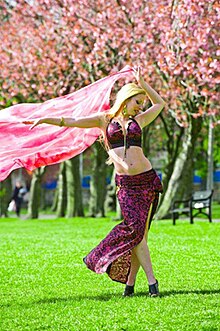
Belly dancer in Edinburgh,Scotland in 2011
American tribal fusion dancer
Rachel Brice
A Turkish belly dancing group
Tribal belly dancing in Australia


Movement found in Belly dance 

  • Percussive movements 
    • it is a Staccato movements, most commonly of the hips.
    • be used to punctuate the music or accent a beat.
  • Fluid movements
    • flowing, sinuous movements in which the body is in continuous motion.
    • be used to interpret melodic lines and lyrical sections in the music. 
  • Shimmies, shivers and vibration
    • small, fast, continuous movements of the hips or ribcage.
    • create an impression of texture and depth movement.

Interesting about belly dance ?

  1.  It is non-impact, weight-bearing exercise and is thus suitable in all ages.
  2.  Good exercise for the prevention of osteoporosis in older people.
  3. Improves flexibility of the torso because the moves involve isolations.
  4. Can help build strength in the upper body, arm and shoulders when dancing with a veil.
  5. Playing the zills trains fingers to work independently and builds strength.
That's all we can update about Belly dance. If you want to know more about the history of the dance you can click this link https://en.wikipedia.org/wiki/Belly_dance. See you in next week .

Friday, 1 July 2016

3) ZAPIN

Hello !! How are you ? Hope you guys are in a good health   ^_^ .
Okay, today we have decided to update a traditional dance in Malaysia. The dance that we are talking about is Zapin. In Asia, many people don't know what is it. That's why we want to story a bit about the dance.

ZAPIN ?

Zapin is a traditional dance of Malay that was most popular in Malaysia. It is believe that has been introduced by Arab,Muslim missionaries from the Middle East in the fourteenth century. The dancers usually perform in pairs and are accompanied by a traditional music ensemble which normally consists of the Gambus,Accordian,Rebab,Marwas,Rebana and Dok. It was also introduced to singapore and brunei before the colonial days of singapore. It was believed that it was introduced to singapore in 1937.

Zapin Dance

Zapin  dance used to be perfomed primarily for religious ceremonies but as time past by it has become a form of traditional entertaiment. Now, there's many forms of Zapin dance and all of it have been changed choreographically from the originals. Among the new "evolved" zapin is Zapin Tengliu from Mersing,Johor,Malaysia. It is said this kind of zapin were created by the fishermen that always gone fishing and within their leisure time on the sea they dance on their big boats or ships follow the flow of the sea waze. If we looked at this Zapin Tengliu, we could say that the dancers dance with their hands holding,gripping the ropes while the body moving around it.

The Interesting Zapin at wedding ceremony

Okay that's all for this week. If you want to know about other dance, so stay tuned !!

Wednesday, 22 June 2016

2) CAPOEIRA

Thank you for stay tuned. For this week we would love to update about Capoeira dance.

Capoeira ?


The name is unique right ? Unique as well as the dance.  Capoeira is known for quick and complex moves,using mainly power, speed, and leverage for a wide variety of kicks, spins, and highly mobile techniques. It's not an ordinary dance but it is a Brazilian martial art with its root originating in Angola and the Congo, that combines elements of dance, acrobatics and music, and is usually referred to as a game. It was developed in Brazil mainly by West Africans, beginning in the 16th century.


On 26 November 2014, Capoeira was granted a special protected status as "intangible cultural heritage" by UNESCO.

Special Facts about Capoeira ?

  • Capoeira improves coordination, cardio, muscle tone, musicality and teaches you a new language and culture other than it fun.
  • You cannot seperate capoiera from music. The game is played based on the tempo and style of the music. the singing and musical instruments are used to play music.
  • in Capoiera, maany movements are carried out while in a handstand position, often resembling modern Breakdance moves.
  • The people who love to learn it will focus on the counter attacks, dodging and attack.

The best Capoeira video ever

The origin of the word "Capoeira" is as shrouded in mystery as the origin of the art itself. Although today Capoeira had a popularity around the world but it history is still a mysterious. So, nothing much history that we can share about this special dance.

Friday, 17 June 2016

1) SALSA

Dear readers, first of all, we will update about the history of salsa.

Okay !!

Salsa ?


A sauce, a recipe, a dance ?  Of course it was a dance . Salsa is a popular form of social dance that originated in the mid-1970's in New York City. It has a strong influences from Latin America, particularly Puerto Rico, and Cuba. Salsa movements have origins in Cuban SonCha-cha-chaMambo and others dance forms, along with the salsa music. Salsa is a dance that was created with a mixture of a many different styles and musical techniques. Salsa is also one of the most dynamic and important musical phenomena of the 1900's. It still remains the most popular style of dance music than other Hispanic communities. Salsa is a distillation of many Latin and Afro-Caribbean dances. West African style Salsa is called Salsa Mbalax. It has more African than Latin features.

Salsa is similar to Mambo in the both have pattern of six steps dances over eight counts of music. In salsa, turns have become more important feature, so overall look and feel are quite different from Mambo. Salsa has more of a side to feel.

Music suitable for dancing ranges from about 150 bpm (beats per minute) to around 250 bpm. Although most dancing is done to music somewhere between 160-220 bpm.


Special facts of Salsa ?


This type of dance can bring a lot of health and social benefits. If you are newly acquainted with this dancing style and you would like to know more about it then here are several interesting facts about salsa :-

  • People of all ages can learn and perform this dance.
  • This dancing style is very alert, passionate, and inspiring.
  • Helps shy people deal with their insecurities.
  • Men's clothing should not compete with female partner's costume as the lady has to be the star of the dance.
  • It has a long history of almost 100 years.
  • Salsa music is very fast-paced.

Here's the best salsa dance that we watch.

World Games 2013 in Cali, Colombia - 1st Place

Thursday, 9 June 2016

Introduction

 Danzar's blog was created because we want to know not only the dance, but also the history and special facts of the dance. We would love to share our knowledge that we have gains to others. It's not like we know all about dance but don't worry, we're still study little by little about dance. We will make sure you guys will be interested to know more and more about the history of the dance. So, we can update once a week while studying or on others words we learn together about dance.


DANCE ?

As we know, dance is a movement that correspond rhythmically when the music was played. Other than that, its also a dance steps and movements that considered as an activity or art form. For some country they dance for a ritual but based on their religion. In this modern world, dance had been use for entertainment. Dance is not only for entertainment and ritual, its also can be one of the ways to express someone's feeling, such as sad, romantic, loving, and etc. but in different style of movement. 

Dance is an art. It depends on the person to do the choreography.


Special about Dancing?


  • It makes people demands a heightened level of anticipation and co-ordination.
  • It can reduces stress and tension for the mind and body.
  • It was connected with happiness.
    • if you don't believe, you remember back. When you happy, sometimes you feel want to dancing and jumping around and sometimes your body will automatically dancing and jumping around.
    • you also feel the happiness when your favorite or good music is playing, 

They dance when they feel happy after good music is playing.


If you wants to know the history, make sure you guys stay tuned!